
Stop Processing Trauma Wrong
The Body First. The Story Later. The Meaning Last of All.

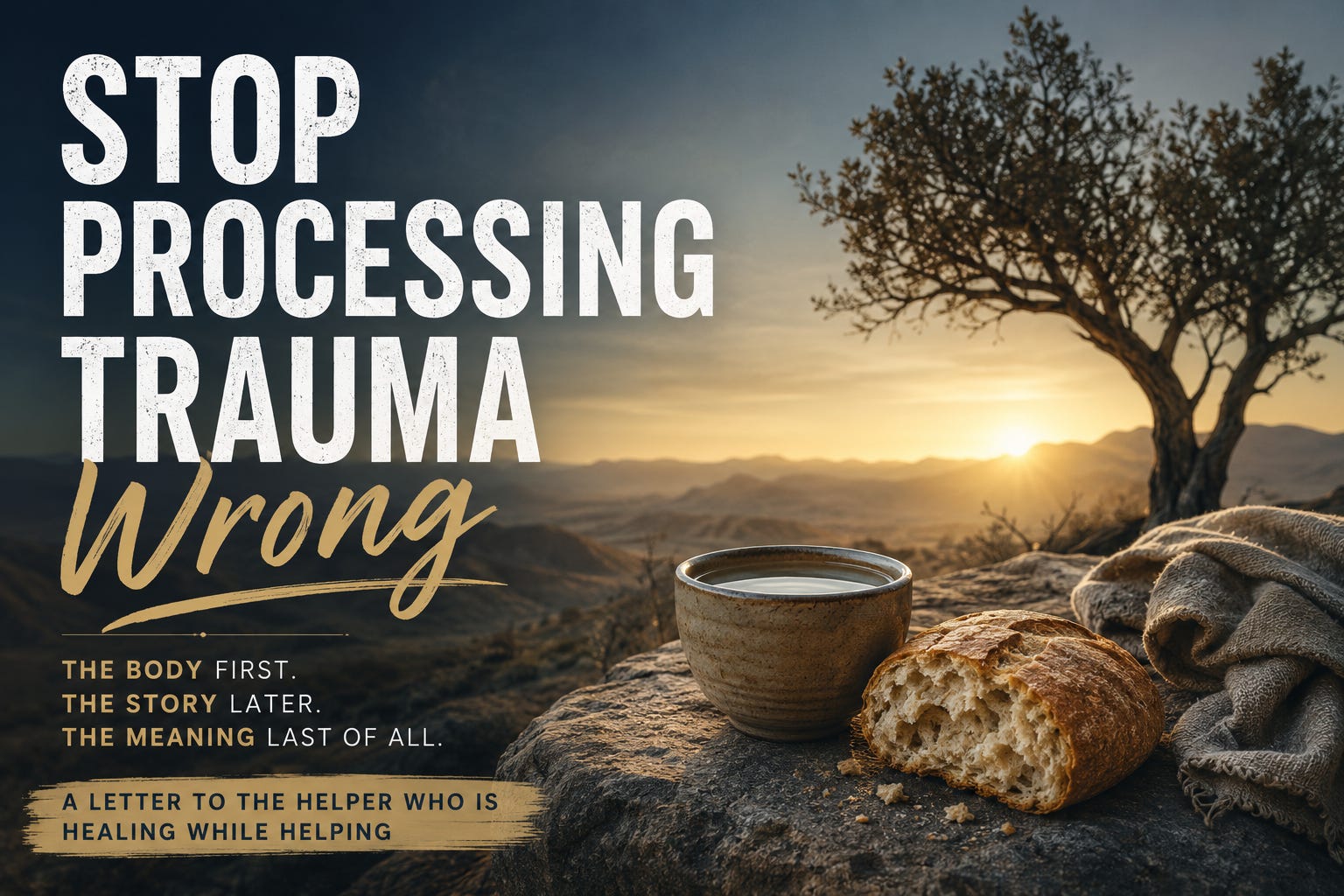
There’s a detail in the Elijah story in the Bible that I keep returning to.
He’s just had the biggest win of his ministry, fire from heaven on Mount Carmel, and within a day he’s under a broom tree in the wilderness asking God to let him die. If anyone ever needed to process, it was Elijah. And an angel shows up and doesn’t ask him a single question about it.
“Arise and eat.”
Bread. Water. Sleep. Then the angel wakes him and does the whole thing again, because the text says, the journey is too great for you. Only later, at Horeb, after the food, the rest, and the long walk, does the question finally come: What are you doing here, Elijah? And even then, the answer doesn’t show up in the wind, the earthquake, or the fire. It comes as a whisper. In stillness.
The body first. The story later. The meaning last of all.
I keep thinking about how often we get that order backward. With our clients, yes. But if I’m honest, mostly with ourselves.
The inheritance we never questioned
You and I were raised in a field born under the banner of the talking cure. That phrase goes all the way back to the beginning, and it smuggled in an assumption we mostly stopped noticing: that trauma is processed by putting it into words. Tell the story. Get it out. Catharsis as treatment.
So we ask the client to start at the beginning. What happened. What happened next. And sometimes you can feel it in the room, that it isn’t working. They’re telling the story, maybe for the hundredth time, maybe fluently, and nothing in them is moving. The words are going around the wound, not through it.
It took me years of practice to fully believe this, so I’ll just say it plainly: talking about trauma is not the same as processing it. Sometimes it’s the opposite. A story told in a dysregulated body isn’t processing. It’s rehearsal. The nervous system runs the old loop one more time and files it, again, under danger.
You already know this. Not from a textbook. You know it because you’ve done it with your own story.
What the body already knew
The research eventually caught up with what our clients had been showing us all along. Bessel van der Kolk built a career on the observation that trauma isn’t stored primarily as narrative. It lives in the body as sensation, image, fragment, impulse. In some of the early brain imaging work, when survivors were exposed to reminders of their trauma, activity in the region tied to speech production actually dropped. Van der Kolk called it speechless terror.
Sit with that finding for a second, because it changes the assignment. When we open with “tell me what happened,” we may be asking for the one capacity the trauma most disrupted. We’re requesting language from a state that is, in a real sense, pre-verbal.
From a Polyvagal perspective, this tracks. Porges’ framework (I hold it as an influential clinical model rather than settled science) describes a nervous system that has to detect safety before the higher stuff comes fully online. Whatever we end up concluding about the mechanisms, clinicians keep coming back to the theory because it names what we see every week: no felt safety, no real processing. A body in survival mode can produce words. What it can’t do yet is integrate.
Bottom-up before top-down.
Breath, rhythm, sensation, the felt experience of a settled person across the room, before insight and language and meaning. Neither direction is wrong. But sequence matters, and trauma usually asks us to start lower than we were trained to start.
Now here’s the part about you
Here’s what I really want to say in this letter, helper to helper.
You are probably the most fluent person in the room when it comes to your own pain. You’ve got the language. You can name your attachment style at a dinner party. You can narrate your childhood with clinical precision, and you’ve done it, in supervision, in your own therapy, maybe in a training where the icebreaker got too real.
And has it moved?
That’s the trap I keep watching helpers fall into, and the one I’ve fallen into myself. We turn our wounds into case presentations. We process out loud, endlessly, articulately, from the neck up, and we call it our work. Meanwhile the body that carries the actual wound never gets the bread and the sleep. It just gets more words.
Henri Nouwen gave us the phrase we all lean on, the wounded healer. But we tend to quote it as permission and forget it was a warning too. Nouwen’s point was never that wounded people automatically heal others. It’s that our wounds become a source of healing only when they’re being tended. An open wound that’s merely narrated isn’t a wellspring. It’s a leak. And a helper who is leaking will keep asking clients to talk about their trauma, because talking about trauma is the only kind of processing the helper has ever let themselves have.
Janina Fisher draws a line I think about a lot: there’s a difference between remembering something and reliving it. Only one of those heals. And the difference isn’t the content of the memory. It’s the state of the body holding it. That’s true in your office. It’s true in your own therapy too.
What processing actually is
So if it’s not recounting, what is it?
Here’s how I’ve come to think of it: processing is having a new experience while touching an old one. It’s the nervous system finishing something it couldn’t finish at the time. The old memory rises, and instead of the old collapse or the old bracing, something different happens. The body stays present. Another person stays present. The moment completes.
You can see it at the center of everything that works. EMDR keeps one foot in the memory and one firmly in the room. Somatic work lets the body complete the movement it had to abort. IFS lets a part that’s been guarding the gate finally be witnessed instead of managed. Different methods, same grammar: not tell it again, but feel it differently.
Processing is not remembering out loud. It is finishing what the body started.
Scripture knew this long before we had the vocabulary. “Be still, and know that I am God.” Look at the order of operations in that verse. Stillness first. Knowing second. The psalmist of 131 says, “I have calmed and quieted my soul, like a weaned child with its mother.” Not a child explaining. Not a child performing insight. A child who has already been fed, resting against a body unafraid.
Even Job’s friends got it right for exactly seven days, the ones they spent sitting on the ground with him saying nothing. Their malpractice started the moment they opened their mouths and began interpreting.
For Monday morning, and for you
A few things I’d invite you to let land this week.
Slow the story down in your office. When a client is racing through their history in a flat voice, the kind move usually isn’t “go on.” It’s “let’s pause here.” Regulate, then narrate. Titration isn’t avoidance. It’s dosage.
Remember that your presence is an intervention before your questions are. Co-regulation comes before self-regulation. The most trauma-informed thing in your office might not be your treatment plan. It might be your own nervous system, settled enough to lend out.
And that’s exactly why the last one matters most: you can’t lend out a nervous system you never let anyone settle. Where in your life is someone feeding you before asking you questions? Who sits with you the way Job’s friends did in their finest hour? If the honest answer is nobody, then some of your exhaustion isn’t a caseload problem. It’s a broom tree problem. You’ve been trying to walk to Horeb without the bread.
I don’t have a clean answer about when the words belong, and I don’t fully trust anyone who does. The words matter. Eventually the story matters. Our field keeps finding that a coherent narrative is part of how healing settles in for good. But the story was never the door in. The story is what becomes possible once the body believes it survived.
So here’s the question I’m leaving on your doorstep this week, and I’m asking it of myself too: where have you been asking for the story, from your clients or from yourself, before the body was ready to tell it?
How is your compassion fatigue or burnout? You can assess it free with our online assessment tool at CompassionFatigue.net
Are you ready to learn more Trauma-Informed Care skills? Take our free course at FamilyHealer.tv
Let Ron Huxley, founder of the Trauma Champions, implement your trauma work with the Survival Quotient (SQ) survey at GrowHeal.me
Sources & Further Reading
Scripture
1 Kings 19:1-13 (Elijah under the broom tree; the whisper at Horeb)
Psalm 46:10 (”Be still, and know that I am God”)
Psalm 131:2 (the weaned child)
Job 2:11-13 (the seven silent days)
On trauma, the body, and speechless terror
van der Kolk, B. A. (2014). The Body Keeps the Score: Brain, Mind, and Body in the Healing of Trauma. Viking.
Rauch, S. L., van der Kolk, B. A., Fisler, R. E., et al. (1996). A symptom provocation study of posttraumatic stress disorder using positron emission tomography and script-driven imagery. Archives of General Psychiatry, 53(5), 380-387. (The neuroimaging study behind “speechless terror.”)
On the nervous system and felt safety
Porges, S. W. (2011). The Polyvagal Theory: Neurophysiological Foundations of Emotions, Attachment, Communication, and Self-Regulation. W. W. Norton.
Dana, D. (2018). The Polyvagal Theory in Therapy: Engaging the Rhythm of Regulation. W. W. Norton. (On co-regulation in clinical practice.)
Grossman, P. (2023). Fundamental challenges and likely refutations of the five basic premises of the polyvagal theory. Biological Psychology, 180, 108589. (A representative scholarly critique; included so readers can weigh the ongoing debate.)
On remembering vs. reliving, and the modalities
Fisher, J. (2017). Healing the Fragmented Selves of Trauma Survivors: Overcoming Internal Self-Alienation. Routledge.
Shapiro, F. (2018). Eye Movement Desensitization and Reprocessing (EMDR) Therapy (3rd ed.). Guilford Press.
Levine, P. A. (2010). In an Unspoken Voice: How the Body Releases Trauma and Restores Goodness. North Atlantic Books.
Schwartz, R. C., & Sweezy, M. (2020). Internal Family Systems Therapy (2nd ed.). Guilford Press.
On the talking cure and narrative
Breuer, J., & Freud, S. (1895/2000). Studies on Hysteria. Basic Books. (The origin of “the talking cure.”)
Siegel, D. J. (2012). The Developing Mind: How Relationships and the Brain Interact to Shape Who We Are (2nd ed.). Guilford Press. (On narrative coherence and integration.)
On the wounded healer
Nouwen, H. J. M. (1972). The Wounded Healer: Ministry in Contemporary Society. Doubleday.
Amazing article.
I also love that you constantly refer to Bible verses, namely from Elijah's ministry and the Psalms, to resonate not only with regular people but also those who are deeply devout to God.
And yes, I do believe experiencing something new, while touching on the previous one, is key to processing trauma and eventually getting over it. I think the biggest part here is presence. After all, it's the foundation of the connections you make with people. If you're not present, then how would you expect to connect in the present?
Thanks for the read, Ron, and I'll definitely keep this article in mind when I need it!
I've come to the point in life where I just try and tell myself a better story about what the trauma I experienced means and in that way let it go. I always loved the stories of Elijah and one of my grandsons is named after him